



Trying out a new format here. Have too many thoughts from a quick trip to Halifax this week that I’d like to expand on, but too little time. So I’m going to share three photos with three brief insights, and I’ll reserve the right to do a deeper post on any (or all?) of the topics at a later time rather than letting them pile up on my desk.

Before I get into the meat of this, I wanted to thank Adam Mongrain of More and Better Housing Canada for inviting me out to a conference in Halifax. I always love getting out to Halifax, which is a genuinely lovely place. It was also nice talking to policymakers and housing people in a part of the country that seems to be moving in the right direction on housing policy, while much of the country is either standing still or moving backwards. It’s a nice reminder that we can get things done when people are rowing in the same general direction.
Now let’s get into it.

Those of you old enough to remember the old Heritage Minute commercials are probably familiar with the Halifax Explosion (1917). A Norwegian ship carrying war supplies collided with a French ship in Halifax harbour, which happened to be carrying a few thousand tons of munitions and explosives. The resulting blast destroyed everything withing 1.5 kilometers of the blast, including an estimated 1600 homes. The death toll from the explosion has been estimated at nearly 2000, with 9000 injured. All in a metropolitan area of around 65,000 people. It’s hard to overstate the scale of the disaster.
A lesser told story is what happened afterwards. The Halifax Relief Commission was created by the federal government in January of 2018 to help rebuild the community. This lead to the creation of Canada’s first public housing community, the Hydrostone District. As a non-architect, I can’t tell you the extent to which it maintains is original form. But it’s still there today, at the foot of the Halifax Explosion Memorial Bell Tower. It’s a pleasant neighbourhood, and a living piece of Canada’s housing policy history that you should check out if you get a chance.
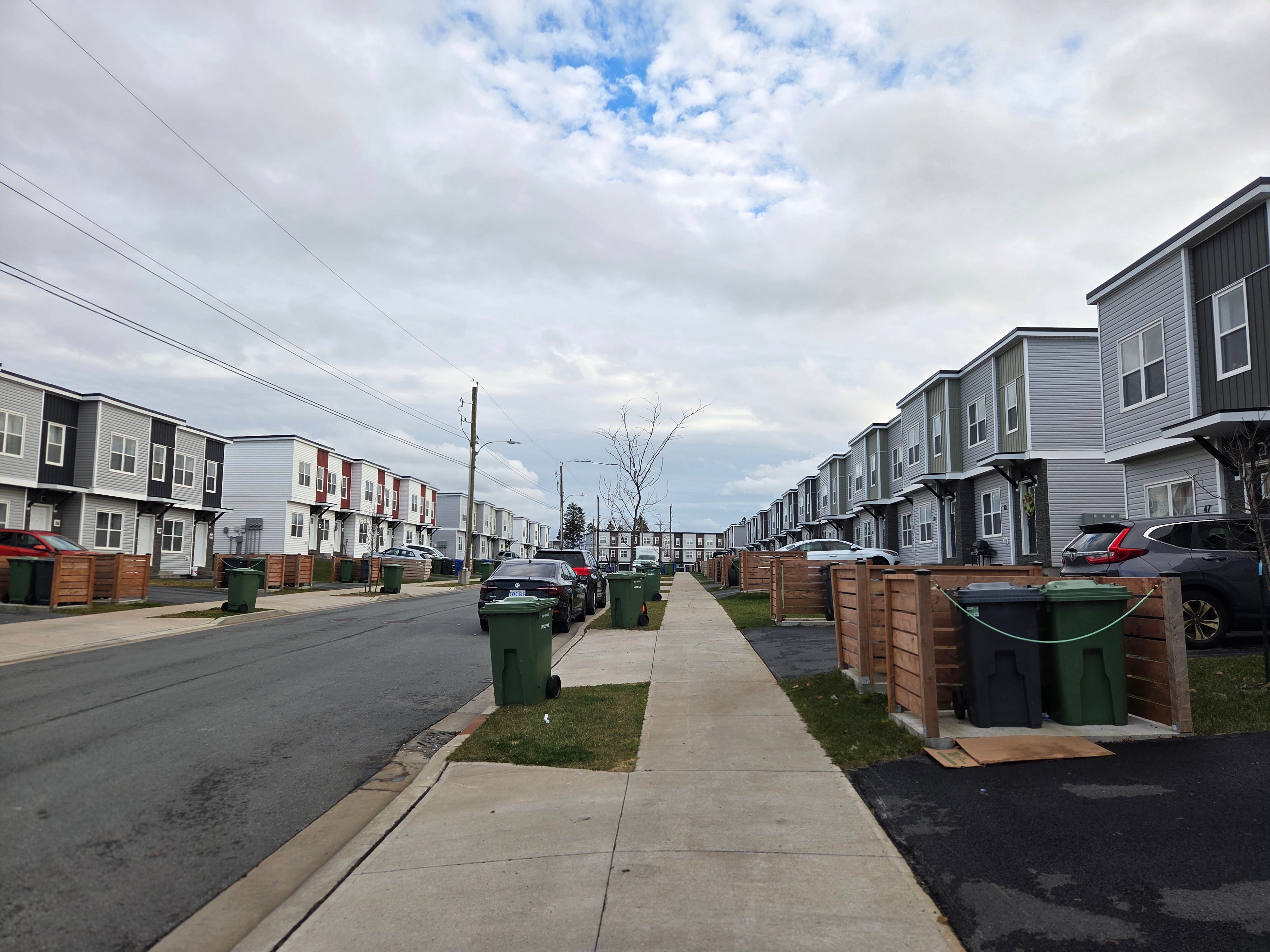
Speaking of the Halifax region leading the way on housing innovation. I was chatting with someone at the conference about modular housing - a hot topic in the housing policy space right now, that attracts wild eyed optimism and cynicism in equal measures. So, naturally, when I heard that there were two different townhouse communities under construction in the region using modular technology, I had to check the out. I’m glad I did.
The photo above is from Mount Hope Village, in Dartmouth. The project will come out to around 900 homes, the majority of which will be in multi-residential buildings on the site. I’m not sure how many of the units will be townhomes, but there are two other streets in the subdivision just like the one above, and it looks like there’s still another phase to come. The apartments appear to be a work in progress, while the townhomes appeared to be mostly occupied (at least the ones I walked by).
Aside from the fact that modular technology figured heavily into the construction, it’s also notable that the YMCA has purchased 57 townhouses in the development, forty of which will be at below-market rents. Building ground-oriented family sized housing with modular technology and turning many of the units into affordable units is rather exciting, if you ask me. Not everyone wants to live in an apartment building. More options for low-income families is great news. Especially if it can be done at scale, competitively. It’s something we haven’t figured out in Ontario. Maybe Atlantic Canada will lead the way.

Finally, something I’ve noticed in Halifax is that you’ll drive through smaller communities in the region where you’d expect to see mostly detached homes, but that have a surprising number of apartment complexes. I’m not going to try to explain, since I don’t have the local context. But it’s interesting to see buildings that would be deemed “out of scale” in many parts of Toronto permitted in wee little Nova Scotia towns that are now part of the Halifax Regional Municipality.
I’m sure many urbanists would view this kind of development as imperfect. I’m guessing the public transit options aren’t amazing, and walkability is probably limited. But housing needs to be built somewhere. It might be preferable to permit enough housing within urban communities to negate the need for suburban density in theory. In practice, that doesn’t tend to happen. If this kind of suburban intensification is viable in Bedford, Nova Scotia, you have to wonder what’s possible in certain communities with GO train stops in the GTA, if they were more open to density.
That’s all for now. Let me know if you think this format is useful or a cop out (or worse - filler). Also happy to expand on any of this in future posts, if it’s of interest.
Great post! Glad you made it to the conference. I think on 3, the planners likely have their own explanation, but I think a lot of it comes down to Atlantic Canada being desperate for any jobs / growth. The instinct to say yes is stronger, which I think we might see with the AI data centers soon too
I like the format, Steve. I'm sure I'm like most people who have several subscriptions to several sources, and sometimes don't get to reading all the articles that I'd probably find rewarding. This piece is a good length that I was able to "sneak in" right after reading my Winnipeg Free Press. Not every post needs to be an opus.